The term vs. tenure "class" divide among faculty at institutions of higher education is a nationwide result of decades of university policies relying on "cheap" term and adjunct labor. Whereas 50 years ago term faculty might have made up a small <10% fraction of faculty (ballpark guess), we are now to the point now where term faculty make up a substantial (>30% at George Mason) fraction of faculty. Term and tenure line faculty come with different job descriptions and expectations for performance, but there are term faculty that work "harder" than tenure faculty, and that can be on multiple axes - research, teaching, service, leadership, etc. However, term faculty are often "stuck" in their track.
To use my own personal experience on this, at Caltech from 2008-2014, I was an assistant staff scientist for five years until I was cross-promoted to an assistant research scientist in my final year there. Like faculty, we had a "class" system as well; we were divided into "staff" and "research" scientist tracks. The expectations were also different for each track - 80/20 vs 50/50 programmatic / research focus. Of course, the research scientists liked to joke it was 80/80, because programmatic work didn't decrease, but that's another story. Like term faculty, the staff scientists were paid less than the research
scientists. We also had promotions within rank - assistant, associate
and full - just like faculty. Just like for term vs. tenure faculty, there were higher expectations of leadership, publications and grant funding among the research scientists relative to staff. There was also more job security on the research track. The similarity to the term vs. tenure lines was intentional. The research scientists also usually occupied the leadership roles. Unlike the term/tenure faculty example, there were many more staff than research scientists.
For me what made this "class" system tenable at Caltech was a key difference - there was a clearly defined and communicated pathway by which one could transition from the staff to the research track. The criteria: performing at the level of the research track scientists. Incidentally, that was also the criteria for promotion within each track, demonstrating performance at the next level already (with a written description of what that meant). Yes, it meant working harder, carving out extra time for research when we already had high-levels of programmatic burdens.
I am unaware of any University that has a clearly communicated pathway from term to tenure faculty, and perhaps that is a result of the administrative drive nationwide to minimize the number of tenure faculty. However, I think we could pursue defining such a pathway in future years - by we I mean my institution. These issues already often come up for term faculty and research staff; the lack of a clear path from non-tenure to tenure lines leads to inconsistencies, unfairness, and frankly term faculty leaving their institutions. This problem has been brewing nationwide for decades as the fraction of term faculty has steadily increased; long-standing trends in administrative policies to save money are coming home to roost.
At Mason, we don't have a clear, written policy on a "sideways" promotion across tracks for faculty, as Caltech did for its science staff. There doesn't exist a national solution to this problem. However, if we could develop a "sideways" promotion criteria, it could be a game-changer in terms of showing how to alleviate the class structure that exists between term and tenure track faculty. As of now, there's an insurmountable barrier, short of winning an open job search. Having a coherent and solid annual performance review process in place is a prerequisite. Caltech did have such an annual review process - We submitted written reports and our bosses wrote written, one page evaluations. Then we had a sit down, in person meeting on every year to review. I used to dread the meetings, but they were always relatively informal and collegial; I grew from them as a scientist and I got honest feedback on my job performance and where I could improve. Our boss and then an ombudsman for the scientists would attend. The ombudsman - a head of science staff - helped protect against favoritism of individual bosses, and got a 30,000 foot view of the whole organization to help guide the bosses too.
There is also a way to sell this to a Provost or University administration: at Caltech, since this process existed, it enabled Caltech to stack the decks heavily with more lower-paid staff scientists, and relatively fewer better-paid research scientists - even more extreme an imbalance compared to the typical ratio of term to tenure faculty. By allowing the pathway for term faculty to become tenure line, I think most Provosts would fear that this would cost them more money. But instead the opposite happened for Caltech - the staff scientists knew what they had to do to get to research faculty as it was clearly communicated; they had to be the best, and it was just very hard. Very few of us successfully made the transition, but many of us tried. This meant more grants, and more publications, this meant more commitment and effort from everyone. As a result, Caltech was able to grow its staff of scientists to be much larger than its research faculty; the role of research scientist was reserved for those that had consistently over-performed for years. And thus I think this would be consistent with long-term trends for Universities to increasingly rely on term faculty. As much as we malign this situation, and would rather increase the number of tenure-line faculty, this nationwide trend does not seem to be reversing any time soon.
The system at Caltech wasn't perfect; far from it; I did decide to leave one of the top institutions in the world for my field of study to become an assistant professor at Missouri State. I had burned out at Caltech. However, if we don't do something like this, as the number of term faculty only continues to grow (w/r/t to the number of tenure faculty) with no outlet, I think the resentment and class structure we have will only get worse. There needs to be a way to tunnel through the barrier. Anyway, that's my two cents tonight. Let me know what you think.
Respondus and other similar webcam monitoring tools discriminate against students of color, invade the privacy of students' home learning environments, foster a lack of trust and mutual respect between faculty and students, and are plainly inhumane and degrading when some students choose to pee themselves rather than get flagged for cheating.
A common retort from faculty and administration is that Respondus and similar tools are necessary to combat rampant cheating during the pandemic. Indeed, some course assessments have seen increased violations of academic integrity during this pandemic, and we agree that these present challenges to the faculty that teach these courses. There are additional legitimate challenges for faculty to retool their curriculum and assessments during this pandemic, with no extra compensation and no extra time.
Namely, many faculty work like the Texas power grid - we operate at capacity, and some would say over-capacity even before this pandemic began; the slightest stress on our system of time management causes a cascade of failures (and in the case of the Texas power grid real harm, tragedy, and loss of life). We don't have the spare capacity to adequately adjust our curricula and assessments, and many faculty also have young children in virtual school at home or to provide caregiving for. It's the stuff of anxiety-driven nightmares.
However, some faculty are simply privileged to be ignorant of the inequities in the use of Respondus and similar tools. Other overworked faculty are aware of its limitations, but weigh the trade offs in investing their time to switch assessments away from Respondus, and decide equity is not a relatively high enough priority. Still others are simply at a loss on how to retool assessments in classes with >50 students; oftentimes alternative assessments require more effort in preparation and grading, and more contact hours which do not scale easily with no corresponding increase in the number of faculty, teaching assistants and learning assistants. Some term faculty are forced to use Respondus to maintain consistent standards across multi-section courses with multiple instructors. We simply don't have the spare capacity to adjust.
So, rather than ban Respondus outright, administrations permit its use; it is "convenient", an easy hi-tech "solution" in challenging times. In fact, many institutions are upgrading and renewing Respondus contracts to avoid compromising the academic freedom of faculty. Higher ed administrations are anticipating that the fraction of courses offered virtually online after the pandemic will remain significantly elevated compared to the "before times"; online courses are a perceived driver of revenue growth and student demand, regardless or whether or not this is in the best interests of the student academic preparation. The pandemic has given the perception that this trend in higher education towards more online courses has abruptly accelerated because of the pandemic. Thus we are using student revenue, and in the case of public institutions taxpayer dollars, to pay a private, for-profit company for the privilege of discrimination.
However, in my opinion, I don't think faculty should have the "academic freedom" to discriminate against their students of color, the "academic freedom" to invade their privacy, nor the "academic freedom" to inhumanely degrade their students. We should hold ourselves to a higher standard. To take the logic of using Respondus to its absurd extreme, imagine if the administration of colleges could require faculty to use Respondus to monitor the faculty, to ensure that we are lecturing from home at the times we are supposed to be, monitoring us for our job performance. I imagine then that Respondus would quickly go away and stop discriminating against and unnecessarily stressing our students.
Instead, let's reset the relationship between students and faculty. Let's question the assumptions that lead to the use of Respondus and similar tools this pandemic. Instead, let's foster trust and mutual respect rather than adversity with our students. I recall the honor code of my undergrad institution "No member of the Caltech community shall take unfair advantage of any other member of the Caltech community." That foundation of trust, instilled in all incoming students at orientation, set the tone of the relationship between faculty and students from the start. We had take home exams as the norm in the late 90s, no webcams required (and the internet was there, but still new then). Yes, some students will still take unfair advantage of that trust, and there needs to be checks and balances in place for genuine violations of academic integrity as are the norm at all institutions. Also, Caltech is a unique institution with its small enrollment, high contact hours, challenging student assessments, and selective admissions, with its own additional well-known institutional shortcomings; not everything can scale.
Faculty can retool our assessments, if given the time, compensation, and spare capacity to do so. As it is, academic curricula and assessments are overdue for an overhaul in the modern era of google search. If an exam question can be answered with googling for the answer, are you really assessing learning? In some circumstances, you are instead assessing memorization. There can and should be new goals for learning and assessment that go beyond memorization. Let's re-evaluate our foundational assumptions of our courses - what do we want our students to take away from the courses, and how can we redesign assessments for those goals in the current learning environment? Instead of using technology to "innovate" surveillance, let's use technology to innovate assessment, to customize student assessments, provide more contact hours or make better use of limited contact hours, and to assist in grading. Let's talk to each other about what has worked and hasn't worked well in our online classes over the past year. Let's ask administrators for the time, and spare capacity, which means hiring more faculty, to invest in our course development.
Think of the stressful situations imposed on our students when some are driven to deny themselves the use of a toilet to answer a multiple choice question. Have we no humanity?
In response to
student concerns, the University of Illinois recently agreed to stop
using online proctoring after Summer 2021. Let's work with our colleagues to join them.
Here are some anecdotal quotes and resources compiled by a colleague of mine:
“Students argue that the testing systems have made them afraid to
click too much or rest their eyes for fear they’ll be branded as cheats.
Some students also said they’ve wept with stress or urinated at their
desks because they were forbidden from leaving
their screens.” And “At the software’s core, he said, “the most clear value conveyed to students is ‘We don’t trust you.’ ” in Cheating-detection companies made millions during the pandemic. Now students are fighting back.” The Washington Post, November 12, 2020,https://www.washingtonpost.com/technology/2020/11/12/test-monitoring-student-revolt/
“It’s become clear to me that algorithmic
proctoring is a modern surveillance technology that reinforces white
supremacy, sexism, ableism, and transphobia. The use of these tools
is an invasion of students’ privacy and, often, a civil rights
violation.”, Shea Swaugerin Software
that monitors students during tests perpetuates inequality and violates their privacy, MIT Technology Review, August 7, 2020
“Yes,
it's quite possible that students working at home in an online setting
could cheat on assignments in ways they may not in a face-to-face
setting. [...] There are two ways to respond: Being OK with this, or setting up a mini-surveillance state.
The first option is the simpler
of the two and so that's what you should go with. Trust students more,
and give them more grace and lenience, than you normally do – even more
than you are comfortable with. You might be surprised how they respond.” Robert
Talbert, Mastery Grading and Academic Honesty, July 20, 2020
“It’s in moments of crisis that you’re most likely
to sacrifice your civil rights,” she said. “But the problem is that once
you sacrifice them, it’s hard to get them back.” In The
Surveilled Student, The Chronicle of Higher Education, February 15,
2021, https://www.chronicle.com/article/the-surveilled-student
AU Mic b: A New Exoplanet in Orbit Around a Remarkable Nearby Star
By Dr Jonathan Gagné
I’m a research advisor at the Planétarium Rio Tinto Alcan of Espace pour la Vie, and I’ll keep you updated with some of our original research here. In this post, I will tell you about the recent
discovery of an exoplanet named AU Mic b. This discovery comes from a
long collaboration with Dr. Peter Plavchan, associate professor at George Mason University,
led since 2010. I joined Plavchan’s team in 2014, and helped them
analyze the data that led to the discovery of this new exoplanet.
An illustration of AU Mic b, a new Neptune-sized exoplanet. Credit: NASA’s Goddard Space Flight Center/Chris Smith, USRA
The name of this exoplanet, AU Mic b, is the same as that of its host star AU Mic, except we added a small "b" next to it. This is how we name exoplanets in astrophysics, a convention endorsed by the International Astronomical Union, who are the authority on the naming of astrophysical bodies. This practice stems from binary stars nomenclature; for example, Alpha Centauri is a binary star, and we name its two stellar components Alpha Centauri A and Alpha Centauri B. We use capital letters for stars, and lowercase letters for exoplanets. If we discover a second planet around AU Mic, we'll name it AU Mic c, and so on—we reserve the letter A (capitalized) for the host star, but we usually keep it implicit rather than naming it AU Mic A.
An illustration of the star AU Mic and its debris disk. Credit: NASA’s Goddard Space Flight Center/Chris Smith, USRA
Before we talk more about the exoplanet AU Mic b, I would like to tell you more about its parent star because it is a special one. Its name, AU Microscopii if we write it down in its entirety, comes from the Microscopium constellation where it can be found. We generally name the brightest star of a constellation with the Greek letter alpha (α Mic), the second one with beta (β Mic), and so on. However, the detailed rules are more complicated than this, especially for the fainter stars of a constellation. AU Mic is far from the brightest star in the Microscopium constellation, and that's why its name doesn't begin with a Greek letter. The Microscopium constellation is located in the Southern Hemisphere, but AU Mic can still be seen from Québec with a telescope, in late August and September evenings.
AU Mic is a young star, aged only about 24 million years, compared to our Sun's 4.6 billion years. We know AU Mic's age because it is part of the "β Pictoris moving group" a giant "stream" of stars that move together in space, and were born from the same molecular cloud. I talk more about these stellar groups in my first blog post—I spend a lot of my time studying them!
A
visualization of all known stars in the β Pictoris moving group,
compared with the position of the Sun, on which the green circles are
centered. The green circles have radii between 10 and 100 light years.
After approaching the regroupment of stars and moving around it, I
stopped the camera and turned on time to view where the stars are moving
towards in the upcoming few million years. AU Mic is part of this group
of stars, born together but not bound to each other gravitationally. A
higher-resolution version of this video is available here.
AU Mic is smaller than the Sun, with about 75% of its size, and half of its mass. We sometimes call such small stars red dwarfs, because they have a cooler temperature, and that gives them a redder color. They are also sometimes called M dwarfs or M stars in technical jargon, and they are popular stars for the search of exoplanets, for a few reasons.
First, they are very common. The physics inherent to the process of stellar formation causes about half of all stars to be born with masses smaller than half that of the Sun (i.e. M dwarfs). The fact that small stars are ubiquitous means that we can hope to find a larger number of exoplanets in total if we consider them in our searches.
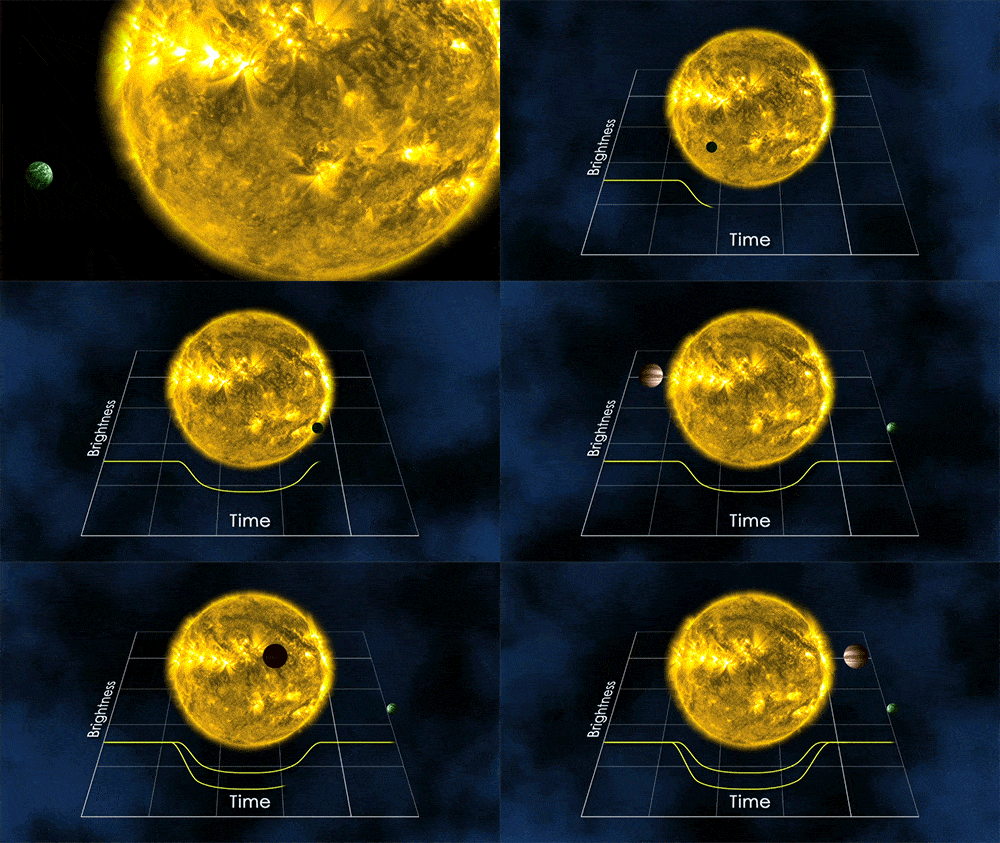
Second, the fact that these stars are smaller, less massive, and dimmer makes them great for the detection of exoplanets. The transit method, whereby we wait for a planet to pass in front its star and make it dimmer, gets us a better sensitivity to small planets when the star is physically smaller. This is true because it is the ratio between the size of the planet and its parent star that dictates how much dimmer the star becomes during a transit event.
This transit method is represented in the video below, where we see the brightness changes caused by planets of different sizes. When we use this method to detect exoplanets, we don't actually see the surface of the star, because it is too far away from us: all that we see is a tiny point of light, which brightness goes down slightly during the transit.
Representation of an exoplanet transit. Larger planets, or smaller stars, will cause a more easily detected change in brightness. Credit: NASA's Goddard Space Flight Center
It is not always possible to detect exoplanets with the transit method, because their orbit needs to be aligned correctly for us to see the planets pass in front of their stars. The transit method also has benefits, however: it allows us to detect exoplanets at very far distances from us. This is why NASA's Kepler mission was so prolific in discovering exoplanets. The Kepler space telescope stared at one patch of the sky for more than 3 years and discovered over 2,300 exoplanets, more than half of all confirmed exoplanets !
A visualization of all exoplanet systems discovered by the Kepler space telescope, over time, and compared with the Solar System planets. Orbital periods and the sizes of exoplanet orbits are to scale, but the sizes of exoplanets are not displayed to scale, otherwise Earth-sized planets would be too small to see them. The exoplanet colors are representative of their expected temperatures, as indicated by the legend. As you can see above, Kepler identified many exoplanets in tight orbit around their star with short orbital periods. This is just because they are easier to find as they transit more often, and it does not mean that all exoplanets have orbits tighter than the Solar system on average. Credit: NASA, Ethan Kruse, music by Kevin MacLeodAnother method often used to detect exoplanets is called the radial velocity method. When an exoplanet orbits around its star, it pulls on the star and causes the star to wobble around a little bit. We can observe that from Earth with our instruments, because the Doppler effect causes the light to become just slightly bluer when the star moves towards us, and slightly redder when it moves away from us. This is analogous to the sound Doppler effect, causing a change of pitch in the sound of a car that moves towards or away from us.
The radial velocity method is what allowed us to discover the first
exoplanets around “normal” stars (some exoplanet candidates were found around pulsars a bit before that). Paul Butler,
my office neighbor and fellow coffee nerd during my first postdoc at
Carnegie Institution for Science in Washington, D.C., is one of the
pioneers of the radial velocity method. He likes to recount how his team
used a device called an iodine gas cell at the telescope to
calibrate their instrument while searching for exoplanets back in the
1990s, and how they were wary that breaking the gas cell would be
extremely dangerous.
An illustration of the radial velocity method to detect exoplanets. Credit: NASA, “5 Ways to Find a Planet”
Once again, smaller stars are good for exoplanet detection with the radial velocity method. The intensity of the star's wobble, and therefore the color shift of its light, depends on the ratio between the mass of the planet and that of its star. Therefore, using the same instruments and telescope, we will be able to detect planets of a smaller mass around stars of a smaller mass.
There is, however, one problem that muddies the benefits of exoplanet detection around small stars: small stars are often "hyperactive", which means that they often flare, have lots of stellar spots, and magnetic storms that cause large and random flashes of visible light, UV and X-ray at their surface. This really complicates the detection of exoplanets, because these random events "pollute" the signal of potential exoplanets, and make our data a lot noisier.
The younger stars are even worse in this regard: for reasons we will not get into this time, young stars tend to rotate faster, and that causes them to have stronger magnetic fields. Magnetic fields are what drive stellar spots, mass ejections and violent storms at their surface, so younger stars with stronger magnetic fields will be even more active. AU Mic is one of the worst possible case scenarios in this regard: it is both small and young. Peter Plavchan likes to call it "Speedy Mic" for this reason, because it is a particularly unstable star that likes to flare a lot.
A visualization of what the star AU Mic A might look like with its large clusters of stellar spots and magnetic storms causing bright flashes in visible light, as well as UV and X-ray. Credit: NASA’s Goddard Space Flight Center/Chris Smith, USRA
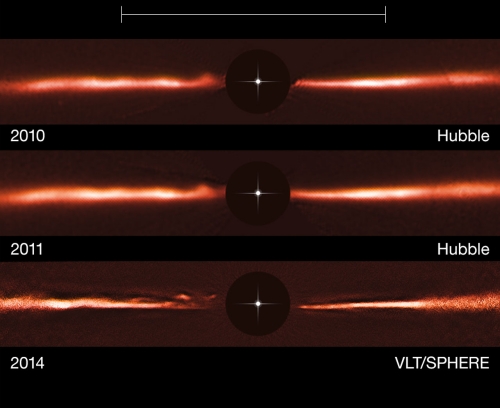
AU Mic is also really cool (and problematic) for yet another reason: it has a massive disk of debris around it. These debris are the result of planetary embryos, also called protoplanets, smashing into each other and getting blown to smithereens. This disk was discovered in 2005, and has been studied extensively since then. Researchers even found that clumps are moving away from the AU Mic at about 40,000 kilometers per hour in its debris disk! It is still unclear to this day what causes this.
Hubble and VLT images of the AU Mic disk. These images show the debris disk at distances up to about 60 astronomical units from the star (one astronomical unit is the Sun-Earth distance), and how its structure changes over time. Credits: NASA, ESA, ESO, and A. Boccaletti (Paris Observatory)
A study led by Cail Dailey using the Atacama Large Millimeter Array Observatory (ALMA) also looked at AU Mic's debris disk much closer in, and saw that some debris are being stirred, causing the disk to be thicker at separations from the star between 20 and 40 astronomical units. They think this is caused by either large planetary embryos, or a hidden exoplanet with less than about twice the mass of the Earth.
An image of the inner debris disk of AU Mic taken by ALMA. This image is zoomed in a lot more compared to the previous ones obtained with Hubble and VLT/SPHERE. Credit: Joint ALMA Observatory, ESO, AUI/NRAO, NAOJ, and Cail Daley (Van Vleck Observatory)
Now, this is a really cool star (in all senses of the word), but it is very hard to search for exoplanets around it because it is super active. We needed something to get past these problems of stellar activity if we hoped to open up the study of exoplanets around small stars in general with the radial velocity and transit methods. One strategy to do this is to stick with the radial velocity method, but look at the star's infrared light rather than its visible light. The signature of stellar activity does not impact infrared light as much as visible light, and the signature of an exoplanet is still apparent in the infrared. However, infrared detectors are a younger technology, making them a lot more expensive and less precise. It is also a lot harder to get a good calibration for these instruments, and this is required to precisely measure a star's color shift as it wobbles around.
This is where Peter Plavchan and his team come in: since about 2010, Peter started collaborating with NASA's Jet Propulsion Laboratory to develop such calibration devices. They built a device called a methane isotopologue gas cell, analogous to the iodine gas cell Paul Butler used, except that it is designed for infrared light (and it is also way less dangerous, thankfully). Peter's team also worked on developing a device even more precise, but way more expensive, called a near-infrared laser comb.
The methane gas cell we used at the Infrared Telescope Facility to calibrate our measurements. The gas cell itself is the transparent cylinder at the center of the photo; it is attached in front of our camera, and will therefore sit between the telescope and the camera. The light we receive from a star will pass through this transparent device, and get imprinted with the unique signature of the methane molecules contained in the gas cell, before making its way to the camera. These molecular fingerprints will serve as a calibration for our scientific measurements.
As soon as Peter got his hands on his methane isotopologue gas cell, he placed it on an instrument called CSHELL at the Infrared Telescope Facility (IRTF) in Hawaii. He began observing some stars near the Earth with his team, focusing on those which exoplanets were inaccessible to visible-light instruments: small stars, and in particular young ones. As you can imagine, AU Mic was one of the first stars they pointed the telescope at, back in 2010.
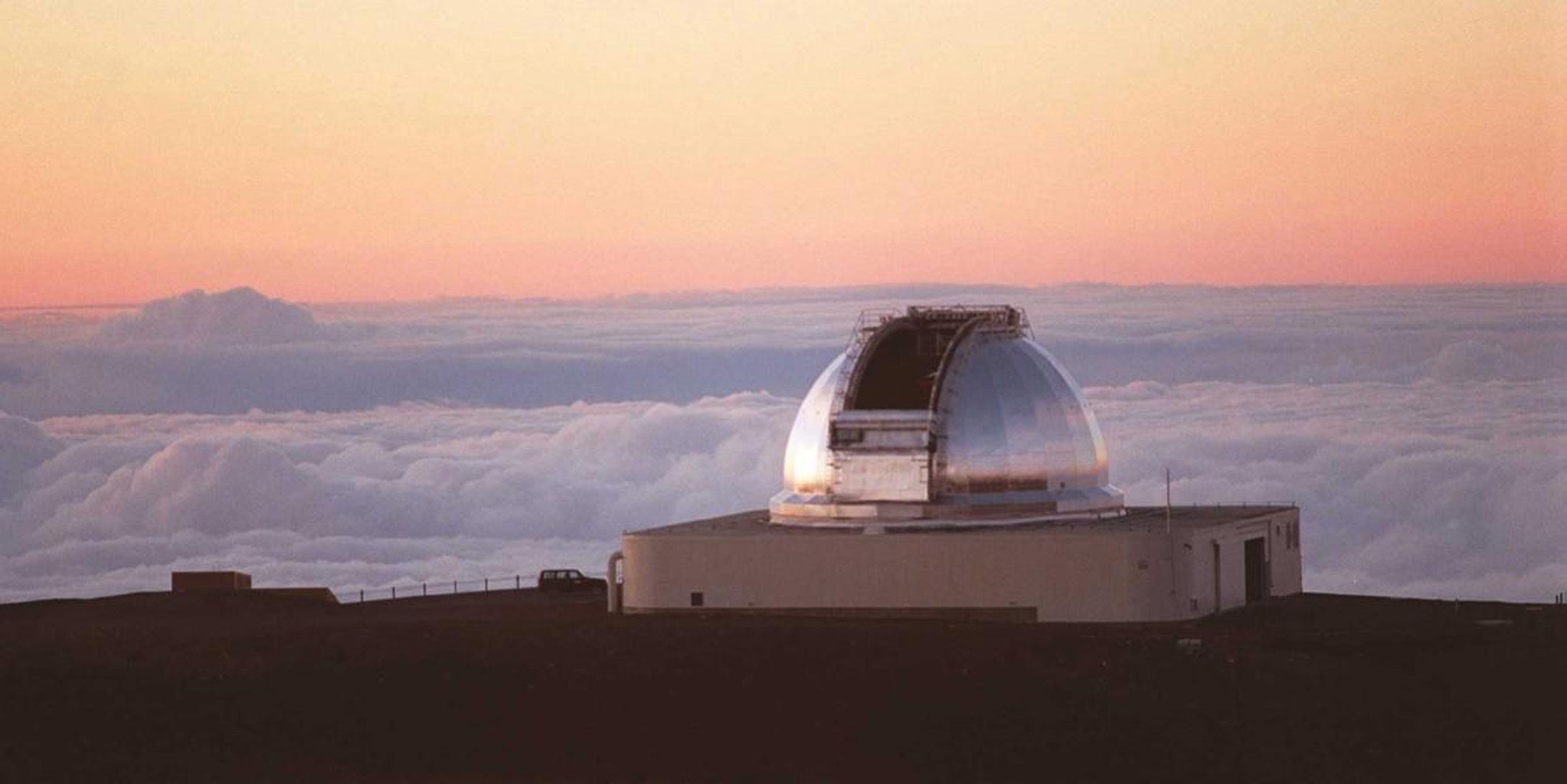
The IRTF telescope, on the Mauna Kea volcano in Hawaii. The observatory literally sits above the clouds. Credit: NASA, JPL
It's only in 2014 that I joined Peter Plavchan's efforts in this project. I was 4 years into my Ph.D., working on the detection of brown dwarfs in young groups of stars, like the β Pictoris moving group with René Doyon and David Lafrenière at Université de Montréal. I applied to an online contest for a 6-months scientific exchange with researchers at the Infrared Processing and Analysis Center (IPAC) at Caltech, and to my delight, I obtained an assignment with Peter Plavchan to work on the detection of exoplanets. So I moved to Pasadena, and excitingly started working with Peter and his team during that next summer. As part of this project, I went to IRTF a few times and observed many stars, AU Mic part of those, with CSHELL and Peter's methane isotopologue gas cell.
Apart from helping with the telescope observing, I spent much of my time in Pasadena writing computer codes to transform the raw data the CSHELL camera gave us into measurements we can use and interpret. This may sound surprising when you are used to taking pictures with a commercial camera, but images that come out from scientific cameras require a lot of work before we can hope to obtain a final product. In this particular case, the final product we obtain for every star, and every night spent at the telescope, is a single measurement of how fast the star is moving towards us, or away from us (this is what a radial velocity measurement is). Pasadena is also where I discovered Copa Vida's single-origin espresso shots, which began a whole other journey for me!
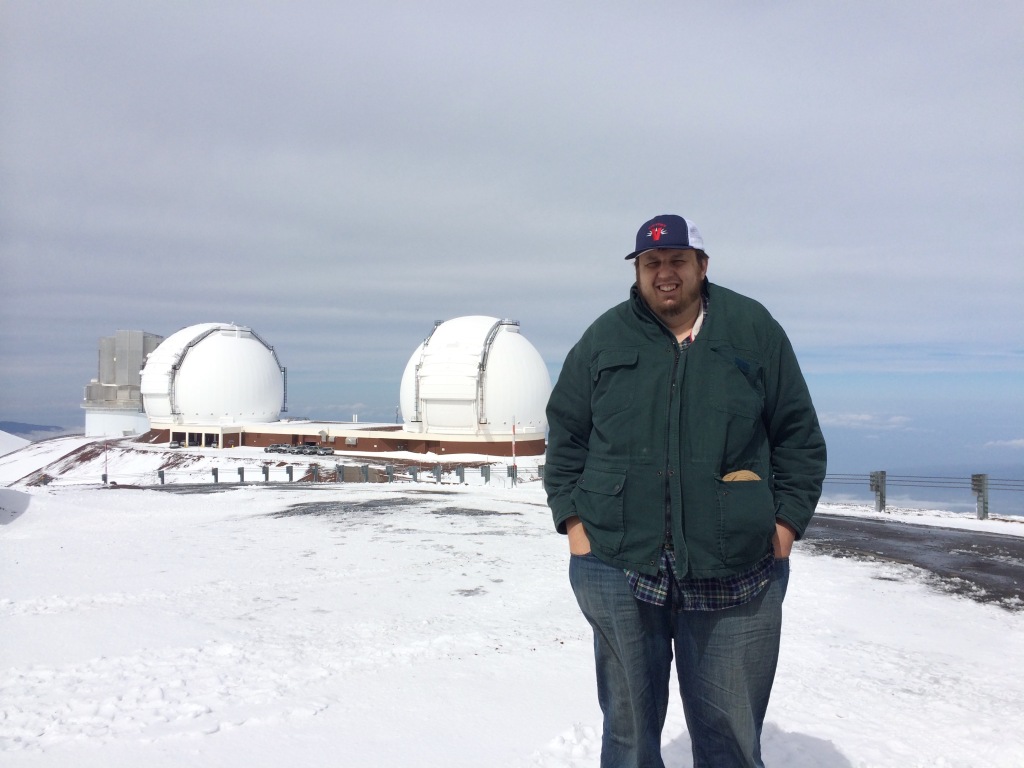
Peter Plavchan and I, staring at the Sun with the Keck telescopes in the background. This is the view we had when arriving at the IRTF telescope, located behind the camera. Photos by myself and Peter Plavchan
When I came back to Montreal after this delightful experience in Pasadena, the work was far from being done—research projects like this one routinely require decades of work, especially when new instrument technologies are involved. I kept my collaboration going with Peter Plavchan, and continued analyzing CSHELL data, and observing remotely with CSHELL, as one of my several ongoing projects. In 2016, I led the writing of a scientific paper that described our first results with this project. Our instruments were not yet precise enough to detect AU Mic b, but we ruled out the presence of a planet more massive than Jupiter in tight orbit around AU Mic. Peter Gao, also part of Peter Plavchan's team during my stay in Pasadena and now a close friend, led another scientific paper in 2016 where he described the algorithm he built to take in my calibrated CSHELL data, and transform it into a radial velocity measurement (yes, this science is so complicated that it required two computer codes, mine and Peter Gao's).
Shoveling snow was part of the job as we got caught in a snowstorm during one of our 2017 observing runs at the IRTF telescope (seen here in the photo). Photo by Peter Plavchan
By the time we published both our 2016 papers, a new and improved infrared camera came up at IRTF. This one, called iSHELL, is similar to CSHELL in what it does, except it is so much better, and in particular more precise. We immediately started using it, and soon after the team started gathering enough data, I flew to Missouri state where Peter Plavchan was now a faculty member at Missouri State University. We sat down with his new student Bryson Cale, and spent the week developing new computer codes for the iSHELL camera in a hack-a-thon style week. They both later came back to visit me in Washington, D.C. during my first postdoc, where we worked more on the computer codes.
Once we started gathering iSHELL data, it did not take long before Peter Plavchan noticed something weird about AU Mic. He emailed us in fall 2016 to tell us that he thought there might well be first signs of an exoplanet hiding in our data. However, this would have been a dangerous claim to make publicly, especially given that we were venturing in an unexplored territory with applying the infrared radial velocity method to an exceptionally active star. We needed to be absolutely certain that what we were seeing was an exoplanet, so we needed to keep observing it as often as possible.
A view of the IRTF telescope's primary mirror from inside the dome. Photo by Peter Plavchan
As we gathered more data, the signal became gradually clearer that there was an exoplanet similar to Neptune around AU Mic. But then, NASA launched the TESS space telescope, and it too observed AU Mic! The TESS mission stared at many stars close to the Sun, hoping to detect exoplanet transit events, like those that we described earlier. As is often the case with NASA missions, TESS data is available to everyone soon after it is observed, and it becomes a gold mine for any researcher to dig in. Obviously, Peter started looking for our new candidate exoplanet AU Mic b in the data that TESS gathered for the star AU Mic, and he found exactly what he was looking for: two transit events seemingly caused by a Neptune-sized exoplanet!
The transit signal also indicated that AU Mic b orbits its star every 8.5 days. This is an extremely short orbital period! Imagine if the Earth orbited around the Sun that fast: our year would only last 8.5 days. AU Mic b orbits so fast because it is very close to its star, at 0.07 astronomical units, only 7% of the distance between the Earth and the Sun. The radial velocity data we have in hand also indicates that the mass of AU Mic b is smaller than 3.4 times that of Neptune, and TESS data indicates that its size is almost exactly the same as Neptune. Interestingly, TESS data also shows hints of a possible second planet, at 0.13 astronomical units from the star (almost twice as far from its star as AU Mic b), and twice the size of the Earth. However, we will need more data to be sure, especially when working with a star as noisy and unstable as AU Mic.
This is a really cool discovery, not only because it opens the door to more research for exoplanets around young and small stars. The fact that AU Mic is so young means that we are catching the exoplanet AU Mic b in the first moments after it formed. Some researchers think it may have formed a bit further from its star, at about 10 astronomical units, and then migrated inwards. If that is true, it means that it must have migrated fast, because it already landed as its current location when the star is still only about 24 million years old.
A video based on a computer simulation, showing
how a planet may form inside the disk of a star, causing spiral waves in
the disk, and later migrate inwards closer to the star. Credit:
Ximena S. Ramos and Pablo Benítez-Llambay
This discovery also gives us a complete picture of what a debris disk looks like in a system that just completed forming an exoplanet like AU Mic b. We know that exoplanets form inside disks around young stars, so we can now look at AU Mic's disk and wonder what imprints AU Mic b might have left on the disk. We can also hope to observe soon exactly how the intense UV and X-ray radiation of AU Mic, as well as its stellar wind, are affecting the atmosphere of AU Mic b. We think that these phenomena could cause the atmosphere to be eroded away. This is an important question because it will determine how hostile to life stellar activity may be for rocky exoplanets around small stars (we think AU Mic b is made of gas, like Neptune).
Another reason why this discovery is so cool is that AU Mic is really not that far from us: it is only 32 light years away, what we can safely call our galactic backyard. It is indeed one of the closest stars to us in the whole β Pictoris moving group, as can be seen below:
A visualization of all known stars in the β Pictoris moving group, compared with the position of the Sun, on which the green circles are centered. The green circles have radii between 10 and 100 light years. The camera moves around the β Pictoris moving group, and then I gradually increase the brightness of AU Mic to show where it is located: it is one of the β Pictoris moving group stars nearest to us. A higher-resolution version of this video is available here.
This system is so close to us that AU Mic b is one of the closest exoplanets we currently know! In fact, only 37 of the currently confirmed 4,171 planetary systems compiled on the NASA exoplanet archive are closer to us than AU Mic. But yet again, an image is worth a thousand words, and a video is worth a thousand images:
A visualization of the AU Mic system location compared with the position of the Sun, on which the green circles are centered. The green circles have radii between 10 and 100 light years. After a few seconds I turn on the locations of all 2,979 currently known and confirmed exoplanet systems for which we know the precise distance from the Sun (required to determine their 3D position). Notice how some of the exoplanet systems form square patterns in the sky when the camera is close to the Sun, at the seventh second of the video near the center of the frame: those are the shapes of the Kepler detectors, back when it always stared in the same direction during its main mission. When we move away from the Sun, we can better see how known exoplanets are located either relatively close to the Sun, or in the direction where Kepler stared. A higher-resolution version of this video is available here.
Peter started the long process of writing up and submitting a scientific paper to the journal Nature, which was finally published this June 24th. This discovery caused quite the media sensation, and even trended on CNN!
Now the science does not end here: Peter got busy teaming up with scientists around the world before publishing his Nature paper, to begin further investigations of this new planetary system. This led to five(!) additional scientific papers, all timed to also become public on June 24th. Four of these teams measured the obliquity of AU Mic b—the tilt between its rotation axis and the axis of its orbital motion, see this video for more explanations—and they all found that the planet's spin axis is aligned with its orbital axis. This is evidence that it indeed formed from AU Mic's protoplanetary disk, and likely did not suffer a cataclysmic collision with other planetary embryos.
There are still many unknowns about how planets form, so discovering young systems like AU Mic b is important to challenge our expectations and refine our understanding of this process. Each one of these discoveries provides us with a "photography" of what a given system may look like at a given age. Remember that one million years is very short at the astrophysical scale, so we cannot wait to see how AU Mic b will evolve, and we need to instead find another similar but slightly older system if we hope to constrain exactly what will happen next in the life of AU Mic b.
One of the five teams mentioned above, featuring other members of the Institute for Research on Exoplanets at Université de Montréal here in Québec, also measured the strength of the magnetic field of the star AU Mic, and how it varies with time. They used this to better understand how the star's activity affected the radial velocity measurements.
Another scientific team tried to measure the atmospheric composition of AU Mic b with a method called transit spectroscopy, but the star was so active that it prevented them from being able to measure a useful signal. NASA's upcoming James Webb Space Telescope (JWST) will probably be able to do this successfully.
Finally, another one of the scientific teams built computer simulations to better understand how AU Mic's stellar wind may affect the atmosphere of its exoplanet. They found that stronger winds will tend to compress the planet's atmosphere, and make it harder to measure its composition with our instruments. They also made predictions about what the transit would look like at a specific wavelength of light (i.e. a color of light). Measuring AU Mic b's planetary transit with an instrument designed to see this specific color only will shed more light on how strong the stellar winds of AU Mic are, and whether AU Mic b's atmosphere is getting eroded or not by the star's violent UV and X-ray emissions.
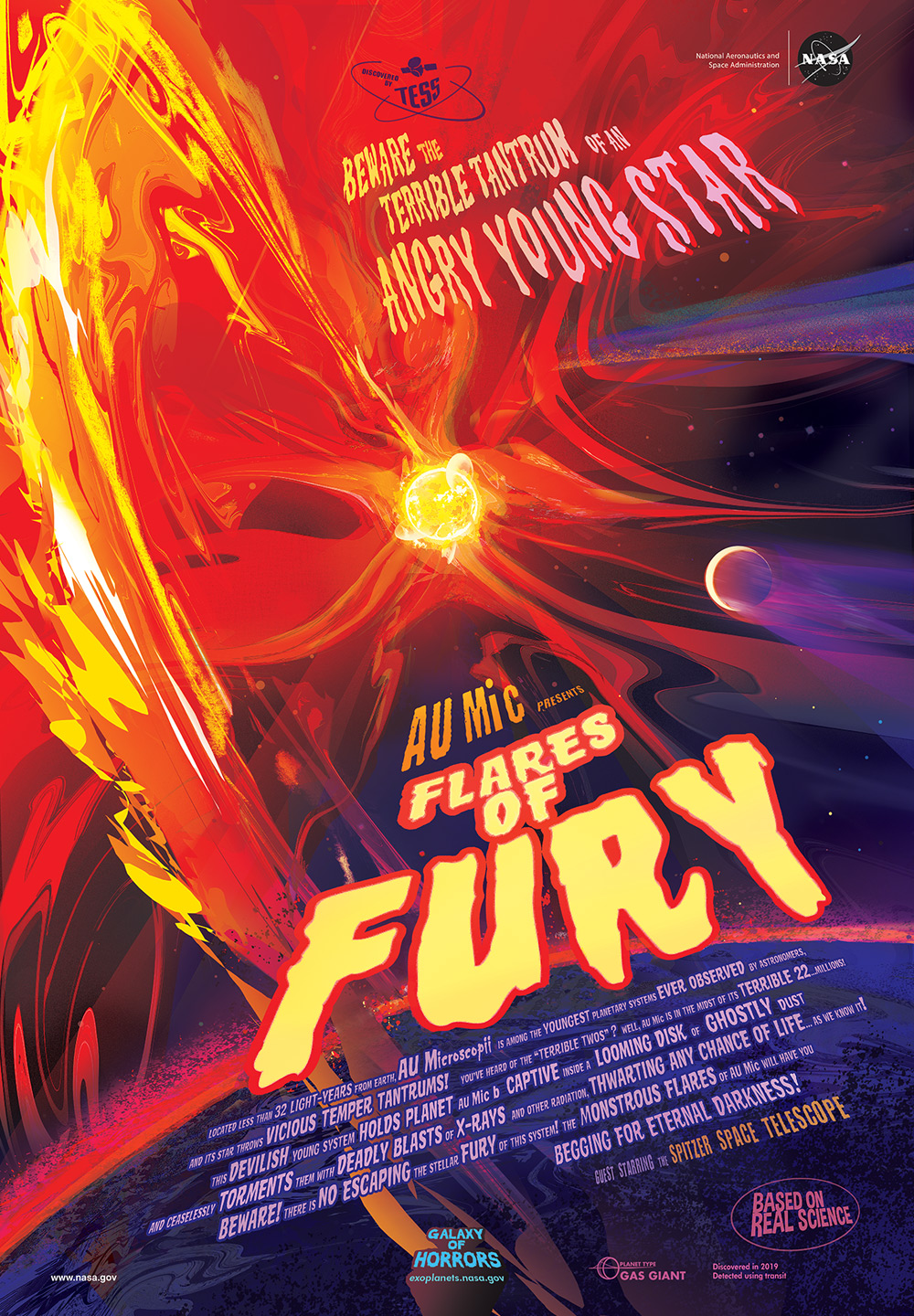
NASA got so excited about this discovery that, on top of all the nice visualizations they made for AU Mic and its planet, they also created this awesome poster:
A promotional poster of the exoplanet AU Mic b. Credit: NASA-JPL/Caltech
I'm super proud to have helped Peter and his team with this discovery, but I also want to emphasize how this is the result of such a long haul, sustained commitment on his part. Peter not only put together the technology to do this and taught several students how to use it along the way (including myself back in 2014), he also led the decades-long observations of AU Mic, and jumped through many hoops to publish this discovery, across many moves, position changes, and obviously, a world pandemic. I sure hope he will line his walls with that poster!
Disclaimer: I am not an infectious diseases expert. This proposal is not to be construed as an official recommended course of action. This proposal has not been reviewed by infectious disease experts,
and this article is a means of seeking feedback from experts and non-experts alike on the
viability and likelihood of success of this proposal. Faculty at George Mason were asked for any input on the re-opening models being trade-studied for fall 2019. This is my edited response:
A Proposed "COVID Cohort" Model for Re-opening College Campuses in Fall 2020
This
proposed cohort model does not eliminate the need for facemasks, cleaning and santitation, and
other social distancing measures in common areas as recommended by draft CDC guidelines. This model
supplements those approaches. This model is under the assumption that we re-open campus to a significant fraction of students and staff; whether or not we re-open campus and under what criteria is beyond the scope of what is discussed here.
The goal of social distancing is to
minimize the number of close social interactions we have to reduce the
rate of community spread of COVID-19.
A plan to re-open a college campus should maintain similar goals.
Under
a normal academic schedule at a typical US college, a college student, let's call her Alice, may take 5
classes of an average of approximately 30 students each. Overlap of
students enrolled between classes, particularly for freshman taking
general education courses, can be a small number or zero. In other
words, if Alice and Bob both take ENG 101 together, the odds of them
taking a second class together is low. Thus on a weekly basis, a single
student like Alice can come into close social contact in their courses
with approximately 150 peer students on average (and likely more given large lectures). In the presence of viral
community spread, if Alice contracts COVID-19, Alice can potentially spread
coronavirus in normal (pre-COVID-19) classrooms to approximately 150 (or more) other
students.
If, however, a University implements a "cohort" model
- a group of students that take classes together - we can reduce the
rates of coronavirus spread by factors of approximately up to five in this toy
model. If instead Alice takes the same 5 classes with the same 30 students, and if Alice
contracts coronavirus, Alice can now only spread coronavirus to 30
students instead of 150 within the classroom setting.
Thus, I recommend college campuses consider a COVID cohort option for re-opening in the fall. We want to
maximize the number of classes students take together in person in common to
minimize the number of distinct physical social interactions a student has. This is entirely aligned with the draft CDC guidelines for childcares and schools re-opening:
"Ensure that student and staff groupings are as static as possible by having the same group of children stay with the same staff(all day for young children, and as much as possible for older children).
Restrict mixing between groups."
This
will be a challenge to implement - students are currently given the
freedom to choose classes independently to suit their schedules, and in fact registration has already begun at many campuses for the fall semester.
However, we know when freshman take general education courses, many
have similar courses in common albeit in different sections or large lectures. Additionally, for upper-class students with declared majors,
many take classes inside their major together. Unfortunately, we have
already passed the time when students have started registering for
classes, and so we may limited to identifying cohorts from students
already enrolled in courses together.
I would like to propose
that upper-class students based upon their declared majors and year be
placed into cohorts by academic advisors familiar with students academic
progress to take the same courses together for the fall 2019 semester,
and to request students minimize or take online only classes for the classes that they can
not take with their cohort. For example, junior physics majors could be
a "cohort", and if they take any classes outside of their major-year cohort, they
must take them virtually online. In addition, to all extents practical,
cohorts should take all of their classes in the same physical
classroom, since the virus can also spread via surfaces.
Similarly,
for freshman that have many classes in common, may I propose that their
schedules be divided into cohorts based upon general education course
sections of ~30 people and their expressed majors or undeclared
interests. Again, if freshman students take non gen-ed classes outside
their cohort or declared major, they be required to take those classes
virtually or online. Another cohort could be honors college students,
for example, again organized by class year, and college or major for
declared students. Students that live off campus could potentially be
given a separate cohort designation from those that live on campus,
especially given that students that live off campus are more likely to
have additional social/work interactions off campus and outside the
campus community. Students
can also be given the option of choosing cohorts that are entirely
online, particularly students that have underlying conditions or concern
of contracting the virus.
To promote the adoption of these student
cohorts of ~30 people in size, may I suggest that the face masks a University
will hopefully be providing to students be given colors or University symbols
of pride or chosen major symbols that let students easily identify when they
are among students from their cohort or not.
For freshmen and
students living on campus, they could be physically located in dorms aligned by
cohort, so that the social interactions of students outside of class
will be similar to the students they have in their classes.
The cohort
model has been shown to promote retention of students (like in
live-and-learn communities), and having students take the same classes
together and live together could lead to overall better academic
outcomes during these times of a pandemic crisis. Some programs already
on campus have identified cohorts (like the honors college). The cohort model for education for retention and identity building
has a strong and positive academic heritage. Organizing classes / dorms
around a cohort model to the practical extent possible could both be
touted as a positive education approach in higher ed and have real
benefits in limiting virus communal spread.
Additionally, cohort model will help
with contact tracing and mitigation for cases that do appear on campus.
Freshman moving onto campus should be encouraged to come to campus two
weeks before the start of the semester, and then isolate together in
their new cohort. At the end of the two weeks, they can be tested and begin instruction.
In
the era of limited testing capabilities, if a member of a cohort during
the semester comes down with coronavirus symptoms or tests positive for
coronavirus, the entire cohort can self-quarantine, and be put on required virtual instruction while the rest of
campus can continue uninterrupted. Members of cohorts can be
periodically tested for coronavirus as representative samples.
This
type of approach would be easier to implement if all professors
teaching in person classes also recorded their classes for posting
online and for remote participation. The faculty, which will teach 2-4
classes, can still get infected as well, and spread the virus to all of
their students. So faculty and staff will have to take extra social
distancing measures - not handing out printed materials but using
digital materials and exams only, for example - to avoid spreading the
virus from classroom to classroom.
Finally, elementary schools
naturally arrived at the cohort model for organizing student education,
by having the same students take the same set of classes, sometimes in
the same room with teachers rotating through classrooms. There is precedent for a cohort model in education in general and higher education specifically.
These articles is related to one of my "deep thoughts" about science.
Scientists have a need for precise communication to other scientists in
order to accurately convey the details of our analysis. As a result, we
have developed what are effectively entirely new languages full of
technical jargon. Reading a biology paper is completely foreign to me.
Even sub-fields within astronomy can read like different "dialects."
For example, we can use different words between fields for
the same mathematical analysis technique. This article is more about
the quality of writing (sentence and word complexity), but the point is
related. I'm glad to see that at least some people are attempting to
understand this phenomenon and its implications. The need for science
communicators (aka "translators") for the general public speaks to my
fear of the (growing?) disconnect between scientific progress and the
public perception of science. I fear that many of our failures - e.g.
global warming, evolution - stem from a failure, or at least an
underfunded effort, to communicate (translate) effectively. I'd even
go so far as to change the typical formatting of a scientific papers in
journals to require as a new standard the inclusion of the equivalent of
an "executive summary" for the public - not just an abstract, but
something free of jargon and comprehensible to a high school graduate.
To summarize: The
output of science shouldn't be accessible to only a select few who
speak a specific "language" that requires years of specialized training
to understand. Years of specialized training to undertake said
research, sure. But not to understand the gist.
Over 2400
students, professors, scientists and journalists will gather at the
Gaylord Convention center in Grapevine, Texas this week to listen to over 1600 talks, explore
exhibit booths, catch up with colleagues, and network. We're here for the 229th meeting of the American Astronomical Society, referred by space.com as the Superbowl of Astronomy.
I'm bringing four of my students to the conference, and my department colleague, Dr. Mike Reed, is also bringing three of his students. Springfield, MO is close to the center of the country, so we decided to make the trip to Texas by car - a 7 hour road trip! (for reference, the east coast is a ~16 hr drive; west coast ~24 hr drive, and Chicago ~8 hrs).
I'm reminded of this scene from the PhD movie sequel:
I've apparently reached the PI career stage
To entice you to attend our posters and talks, below is a list of what Dr. Reed, myself, and our research students will be presenting. Four students (marked below with an *) are applying to PhD programs, so if you are on a grad school admissions committee be sure to talk to them! Many more of my former students are also going to the AAS meeting, and I
look forward to catching up with them, listening to their talks and
seeing their posters.
First year masters student, Bryson Cale*, will be giving a talk on Saturday morning (11:10-11:20am, Texas D, Session 403. Extrasolar Planets Detection: Radial Velocity II). Bryson will present the motivation and first light observations with an isotopic methane gas cell on the iSHELL spectrometer at the NASA Infrared Telescope facility. Our goal is to measure relative radial velocities of stars to better than 3 m/s precision to search for habitable zone exoplanets around M dwarfs, and to confirm planets discovered by the TESS mission.
Bryson Cale
First year masters student Patrick Newman*, will be presenting a poster on Wednesday (146.10 Extrasolar Planets: Detection Poster Session). Patrick is working on radial velocity survey yield simulations for input into a future flagship direct imaging mission like WFIRST, HabEx, and LUVOIR. WFIRST will be launching in the 2020s, and HabEx and LUVOIR are under study right now for the 2020 Astrophysics Decadal survey for launch possibly in the 2030s.
Patrick Newman
Senior undergraduate Ryan Hall*will be presenting a poster on Wednesday (146.14 Extrasolar Planets: Detection Poster Session). Ryan is the current lead of MICRONERVA, an array of small eight-inch telescopes to work robotically and autonomously together to synthesize the light gathering power of a larger telescope. Ryan will present on the current capabilities and development of the prototype array of four telescopes. Ryan and I will also be presenting at a splinter meeting for the MINERVA team on Thursday.
Ryan Hall
Senior undergraduate Shannon Dulz* will be presenting a poster on Thursday (245.13 Extrasolar Planets: Characterization & Theory Poster Session) on measuring Transit Timing Variations of two Kepler planetary systems. Shannon developed her own custom code, using a custom transit shape model to speed up the transit fitting process in determining the time of transit midpoint.
Shannon Dulz presenting at a conference in April 2016
Junior undergraduate and computer science major Frank Giddens will be demoing (at Ryan Halls poster) his node.js web server interface to MICRONERVA, complete with Python bridges to the hardware. Watch with us on a webcam as we remotely control the telescope and accessories back in our lab 400 miles away, as long as we don't have any live-demo technical difficulties!
Frank Giddens
Undergraduates John Crooke and Ryan Roessler will be presenting a poster (433.17 Stars of Many Stripes Late Poster Session) on their work with Dr. Reed on the asteroseismology of the subdwarf B star PG 1219+534.
I (Dr. Peter Plavchan, Assistant Professor, Missouri State University) will be presenting a talk on Friday (2:40-2:50pm Texas DSession 320. Extrasolar Planets Detection: Radial Velocity I). I will be presenting the discovery of a candidate Jovian exoplanet around AU Mic! The paper is drafted and circulated to co-authors, and will be submitted soon!
My colleague Dr. Reed will be presenting a talk on Wednesday (3-3:10pm Texas 4 Session 130. Variable Stars, Asteroseismology) on his latest research on the asteroseismology of subdwarf B stars.
I'm ready for the kickoff for the astronomy Superbowl!